5. Incorporation of Japanese Music Theory
On the whole, traditional Japanese composition takes a different approach from Western composition. In a discussion of the major building blocks of music, pitch will be explored first, as this area contains the aspects that are the most dissimilar to Western music.
5.1. Pitch
Japanese music was initially based on Chinese theories of scale and mode - in particular, the modes of Tang popular music (Malm, 1959). Of the twenty-eight Tang modes that were imported, six of them became a staple part of Japanese music theory. These modes (in their original Gagaku form) are shown in figure 3, and they can be divided into two main categories; ryo and ritsu. Taishikichō, Sōjō and Ichikotsuchō are ryo modes, where the third degree is major. Banshikichō, Hyōjō and Ōshikichō have a minor third, and are therefore ritsu modes. This categorisation is familiar to the Western concept of major and minor scales, although many of the scales that will be discussed later do not actually contain thirds (see note 1).
According to Malm (1959), there were two main rules that dictated the use of these modes. Firstly, a mode could not be transposed to another key, as is possible in Western music. Pieces could only start on the first notes given in the table above. Secondly, a piece could not move between a ryo and a ritsu mode mid piece. These restrictions were due to the fact that the Gagaku instruments could not easily play the chromatic tones that would be required if the piece was to be transposed in to another key. A reoccurring decision in this project was how closely to stick to the original theories and rules. For example, modern orchestral instruments do not have the same restrictions as the Gagaku instruments, so the rules above are less relevant to a contemporary composition such as the Fantasia. As a result, the composition approach was to use the theories accurately, but to disregard any rules that do not apply to the instruments for which the piece is written.
One of the main themes in the Fantasia is constructed from the notes of the Ōshikichō mode. Figure 1 shows the Ōshikichō theme as first heard on the bassoon at bars 54 - 61. When the theme is broken down in to phrases, it can be seen that the first phrase uses all of the notes in the mode, which helps to firmly establish the tonality. The theme uses techniques such as repetition and sequences to aid the melodic flow. Additionally, these techniques make the melody more memorable, as after listening to it once, the melodic and rhythmic elements have essentially been heard a number of times already.

Figure 1. The Ōshikichō theme
The second of the Gagaku modes to be utilised is Ichikotsuchō. This is a ryo (major sounding) mode, which was selected for use in a lyrical theme. As with the Ōshikichō theme, the melody has repeated and developed phrases, which gives structural completeness. Figure 2 shows the Ichikotsuchō theme as first heard on the piano at bar 141.

Figure 2. The Ichikotsuchō theme
The harmonic aspects of the passage have been removed so that the theme can be clearly seen. When composing this passage, the particular chords were chosen because they fitted exactly with the tones of the Ichikotsuchō mode. Once the basic chord progression had been established, the harmony was developed by adding tones from outside of the mode (see section 7 for more details). These notes allow the music to modulate more frequently, as well as adding colour to the sound. Figure 3 shows the harmonised version of the Ichikotsuchō theme.
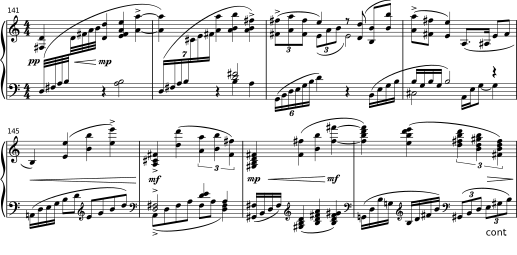
Figure 3. A harmonised version of the Ichikotsuchō theme
One standard theory of Japanese scale construction only allows five notes to be used (Koizumi, 1977). These pentatonic (five tone) scales can be derived using the ‘nuclear tone’ (kakuan) theory. According to this theory, most Japanese modes can be expressed using three-note tetrachords. These tetrachords contain two pitches, a perfect fourth apart, with a third pitch (the infix) positioned in between. The two outer tones of the chord are known as the nuclear tones, and the infix is a variable pitch that defines the tetrachord. There are four types of tetrachord, which are named as follows:
A complete pentatonic scale can be created by joining two tetrachords together. A few of the most commonly used scales in Japan, and subsequently in the Fantasia are:
Note: It was stated previously that Ritsu modes have a major third. However, in the case of the Ritsu scale (and some other scales), there is no third. In Japanese Music, the third is not considered to be vital, as in Western music. It is the infixed note that controls the quality of the tetrachord. However, when using Japanese scales in combination with Western harmony, it is necessary to view the scales with Western theories in mind.
In addition, the increasing Westernisation of Japan led to the Western pentatonic major and minor scales becoming commonplace in Japanese compositions from the last century (Malm, 1959).
It should be noted that the pitches given above are only Western translations. In reality, the infixed pitches have subtle differences in tuning (Tokita and Hughes, 2008). These microtonal tunings can change from one performance to the next, or even change within a single composition. It was decided not to use microtones in the Fantasia, as it would make the piece significantly more difficult to perform on Western instruments.
The first few bars of the strings provide a number of examples of pentatonic scales in the Fantasia (see figure 4). Here, the semiquaver pentatonic scales are the main feature of the music, and they introduce the listener to the Japanese sound-World. These scales are also repeated by the woodwinds on the fourth and fifth beats of the bar, giving a continuous stream of notes, while at the same time, giving the listener chance to digest each segment. Due to its less dextrous nature, the double bass plays quavers (skipping every other note). This consequently produces further pentatonic scales.
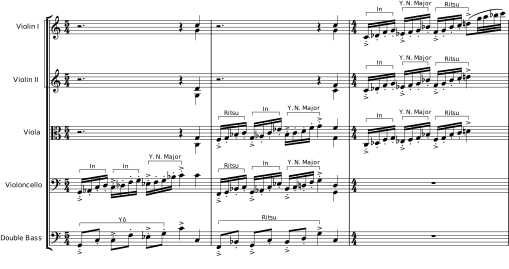
Figure 4. Pentatonic scales in the opening bars
The pentatonic semiquaver patterns seen in the introduction continue throughout the piece as an accompaniment. Figure 5 demonstrates how the patterns are passed from one instrument to the next in the introduction (bars 7 - 22). Moving the pattern through the instrumental sections ensures a consistent texture, while eliminating the fatigue of repetition.
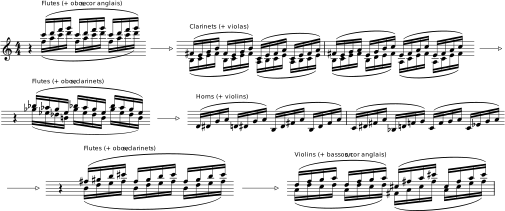
Figure 5. Transferal of the pentatonic accompaniment pattern through multiple instruments
The final pentatonic scale used in the composition is Kokin-choshi. Koizumi (1977) classifies this as a combination of the Miyako-bushi and Min’yō tetrachords, giving the notes C, Db, F, G, Bb, (C). This scale is the basis of a short phrase that is first heard during the introduction. Figure 6 shows the phrase as played by the first violins at bar 11. This is one of a number of Japanese scales that starts with a minor second. It gives a distinctly oriental and slightly mysterious sound. This example additionally demonstrates the use of grace notes in the melodic lines. This is very common practice in Japanese music, and it adds to the lyrical quality of the music (Nelson, 2008).
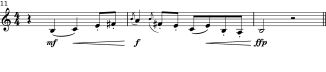
Figure 6. Usage of the Kokin-choshi scale
5.2. Rhythm
A recurring aspect across all of Japanese music is the use of standard rhythmic patterns. Malm (1959) explains how many of the early instruments relied almost exclusively on basic patterns. For instance, music for the wagon (a zither - predecessor to the koto) was composed of only four patterns, which were then varied in different ways. These patterns are given in figure 7 and an example use of the oru pattern in the Fantasia is shown in figure 8. In their original context, the phrases were used to signal the starts and ends of ceremonial pieces, and in some forms of Japanese theatre, they provide cues for the actors/dancers. As these factors do not apply directly to the Fantasia, the patterns are used for their rhythmic value only, and not for any specific structural or performance related purpose.

Figure 7. The standard wagon patterns (after Malm, 1959)

Figure 8. Usage of the oru pattern in the Fantasia
An additional example of standard rhythms are the Ozatsuma patterns (Malm, 1959). There are forty-eight of these patterns, which would usually be played on the Shamisen (lute) in Kabuki theatre music. A few examples, as used in the Fantasia, are shown below in figure 9. The pitches associated with these patterns vary, but according to Malm (1959), the four patterns displayed below are designed to mimic the downwards curve of speech. Therefore, when used in the composition, the melodic shape of these patterns has been retained, as in the original Japanese transcriptions.

Figure 9. Example uses of the Ozatsuma patterns in the Fantasia
Other types of rhythm, can be found in Nō - the most ancient form of theatre music found in Japan (Kishibe et. al., 2012). It consists of narration, singing and dancing, with a musical accompaniment from drums and a basic flute. The vocal elements of Nō primarily use three different types of rhythm. These are shown in figures 10 - 12. Ōnori (large rhythm) is simply one syllable per beat. This is a heavy rhythm that is used extensively in battle scenes. It is however also used for heavenly dances, when the tempo is far slower. Chūnori (medium rhythm) has two syllables per beat. This is also used for battle scenes, as the greater number of notes gives the impression of speed. The final, and most complicated rhythm, is Konori (small/normal rhythm). This is comprised of groups of seven plus five syllables, distributed over an eight beat musical phrase. Despite the syncopation involved, this rhythm has a smooth and natural quality. It is usually found in love scenes, for example (Takanori, 2008).

Figure 10. Ōnori rhythm (after Takanori, 2008)

Figure 11. Chūnori rhythm (after Takanori, 2008)

Figure 12. Konori rhythm (after Takanori, 2008)
In the Fantasia, the Nō rhythms are used extensively in the central section. Firstly, Konori is heard on the cello at bar 161 (see figure 13), and then repeated and elaborated by the piano at bar 165. The natural quality of Konori makes it the ideal rhythm to follow on from the lyrical Ichikotsuchō theme.

Figure 13. Implementation of the Konori rhythm
The Chūnori rhythm (shown in figure 14) can be seen in the piano part from bars 206 - 209. This rhythm builds up the movement towards the proceeding dramatic bars.

Figure 14. Implementation of the Chūnori rhythm
The Ōnori rhythm is used at bars 202 - 205, and to a greater extent at bars 210 - 213 (see the strings reduction in figure 15). The orchestra is largely playing tutti at this point, increasing the drama and weight of the passage (also see section 6.1). Another common Japanese technique in theatre music, which is reflected in these bars, is a gradual rise in tempo (Rose and Kapiscinski, 2010).

Figure 15. Implementation of the Ōnori rhythm
5.3. Harmony
Malm (1959) explains that on the whole, Japanese music is monophonic. Many genres are simply singing/narration accompanied by percussion, so there is little harmony involved. When instruments do combine, it is rare to find intervals other than unisons, fourths and fifths. Most of the basic Western concepts of harmony, such as chord progressions and cadences, do not exist as such in Japanese music. The harmony used in the Fantasia is mainly based on Western harmony, making free of all of the pitches in the chromatic scale. Details on the western styles of harmony used in the composition are given in section 7.
One Japanese instrument however does have harmony as its main function. This is the sho; a set of seventeen reed pipes with a wind chest underneath. Blowing into the wind chest while selectively closing holes in the pipes can produce eleven different chords. The chords however, are not utilised in the same way as in Western harmony. They do not form chord progressions and cadences; they act more like a drone that creates a solid texture. According to Malm (1959), “(T)he chords of the sho (...) freeze the melody. They are like a vein of amber in which a butterfly has been preserved. We see the beauty of the creature within but at the same time are aware of the solid between us and the object, a solid of such a texture that it shows that object off in a very special way.” The chords themselves could be described as ‘tone clusters’, and they are shown in figure 16.

Figure 16. The chords of the sho (after Malm, 1959)
Malm (1959) states that the sound of the sho is kept continuous by using both inhaled and exhaled air, and by starting chords in the middle of a bar. This effect is recreated in bars 261 - 267 of the composition. The woodwinds start the chord quietly at the beginning of each bar, and the brass starts its chords mid bar. The woodwinds and brass then crescendo/decrescendo at different moments, giving a consistent yet swelling texture between the two sections. This is shown as a simplified reduction in figure 17. When incorporating the sho chords in to the composition, it was necessary to transpose them to fit with the other musical ideas. Using them in this way does create a Western-like chord progression, but they still succeed in creating a drone like texture that frames the melody, as Malm describes.
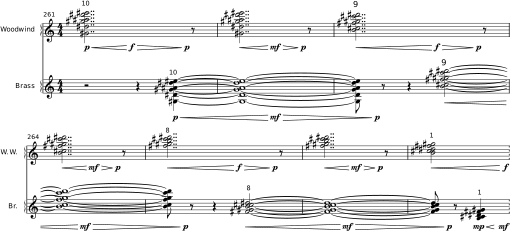
Figure 17. Usage of the sho chords in the Fantasia
5.4. Koto Music
Of the many Japanese instruments, the koto is perhaps the most well known in the West and the compositional approaches used in koto music provided a number of inspiring ideas for the Fantasia. Like many other Japanese instruments, the koto was imported from China and slowly adapted over time (Kishibe et. al., 2012). It consists of a 185 cm board (usually made from paulownia wood) with silk or nylon strings running horizontally along it. The instrument has a number of bridges that can be moved to adjust the tuning. It is plucked with three fingers of the right hand (using plectra), while the left hand changes alters the length of the strings.
Of the many possible tunings, Hirajoshi and Kumoijoshi are the most popular. They are tuned to the notes of the Yō and In scales respectively. Examples of their use in the composition are given figures 18 and 19. These examples form part of a short piano introduction (bars 25 - 47) that makes improvisatory use of the koto tunings. Traditional koto pieces can consist of a minimal amount of notes, or be virtuosic (Kishibe et. al., 2012). The piano intro in the Fantasia reflects these two extremes. Pauses, silences and slow tempos are used to reflect the minimal style, and arpeggios between the hands at higher speeds portray the virtuosic aspects. The harmony in this section is very static, which helps to create the meditative feel of koto music.

Figure 18. The Hirajoshi koto tuning, as used in the Fantasia

Figure 19. Usage of the Kumoijoshi koto tuning in the Fantasia
5.5. Structure
According to Takanori (2008), Japanese music largely is formulaic in its construction. One of the most important concepts is that of the dan - a kind of musical paragraph. This concept is most commonly used in Nō, Kabuki, Hieke and Sōkyoku (koto music). A whole piece will consist of multiple dan, usually four to eight. In Danmono, a sub-genre of Sōkyoku, the sections have a fixed length of 54 beats. Because of this fixed length, two different dan from the same piece (or from some other related piece in the same tuning) can be played at the same time by two kotos (Malm, 1959). This technique is called Danawase. The Fantasia borrows this idea on a smaller scale during bars 350 - 354. In figure 20, a section of the lyrical Ichikotsuchō theme is played simultaneously with the Ōshikichō theme.
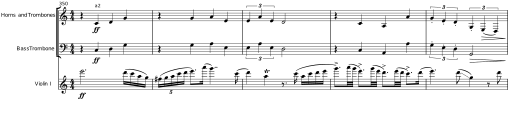
Figure 20. Example of the Danawase technique
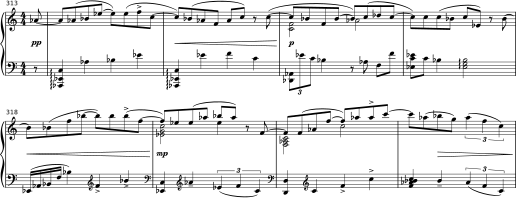
A similar technique of structural manipulation is Dangaeshi. This is where a dan is played simultaneously with a variation of itself (Malm, 1959). This type of technique is used during the piano solo between bars 318 and 325. It uses the theme in Konori rhythm from bars 162 - 165 and the variation on that theme (bars 141 - 148) as the two sections to be played simultaneously. Instead of having two of kotos, the piano is capable of playing multiple themes. Figure 21 shows how the theme is played with right hand, and the variation is played in the left hand. The piano solo is near the end of the composition, and combining themes in this way is an effective way to sum up the events so far, in preparation for the climax. Both Danawase and Dangaeshi reinforce the Japanese tendencies to reuse small amounts of source material wherever possible.